OGDC 2025 Status Report
Sustaining Momentum: CEO Champions Foreword and Executive Summary
The global energy landscape continues to evolve rapidly. Economic growth, increasing access to digital technologies and the emergence of artificial intelligence (AI) are driving new patterns of energy demand, particularly in emerging economies where energy access remains vital to social and economic progress. Meeting this growing demand, while reducing emissions and developing low-carbon solutions and technologies for the future, is one of the defining challenges of our time.
The Oil and Gas Decarbonization Charter (OGDC) was launched at COP28 in 2023 as a collective response to that challenge, and we are pleased to see that as a coalition, it is sustaining momentum. Two years on, OGDC has become one of the most significant multilateral industry initiatives. Today, 55 signatories representing around 40% of global oil production with operations across more than 100 countries are working together to accelerate measurable progress. Importantly, two-thirds of the signatories are national oil and gas companies (NOCs), reflecting the Charter’s unique reach and diversity across the energy landscape.
This year’s progress demonstrates the importance of shared accountability. 50 of the 55 signatories submitted data for this report, representing 98% of OGDC operated production, providing a more comprehensive picture of the sector’s carbon footprint than ever before. 35 companies have also reported previously unpublished data to OGDC, demonstrating the Charter’s unique ability to drive the industry towards strengthened transparency and consistency.
Moreover, 13 additional signatories reported action plans to achieve the Charter’s ambitions for near-zero methane emissions and zero routine flaring by 2030, and net-zero Scope 1 and 2 emissions by or before 2050.
Collaboration among signatories continues to deepen, with more than 2,000 signatory professionals taking part in technical workshops and joint training programs in 2025. New partnerships and initiatives are accelerating learning and driving the adoption of advanced technologies, such as AI, across the Charter.
OGDC’s pragmatic, collaborative approach is proving its value in supporting companies to advance their decarbonization goals. As this year’s data also shows, better measurement remains essential. While reporting coverage has expanded, data quality and completeness must continue to improve to accurately track emissions reductions across the sector.
As we look ahead to 2030, the 2024 baseline survey will remain our benchmark for tracking results.
By strengthening the quality of our data, deepening collaboration and raising collective ambition, we will continue to turn ambition into measurable action that accelerates progress to decarbonize our industry at unprecedented scale.
Executive Summary
OGDC was launched as a global platform for action, collaboration and transparency in reducing emissions from the energy sector. Two years on, companies are maintaining momentum and showing notable progress towards the aims of the Charter. More companies are reporting and more companies have interim ambitions and action plans.
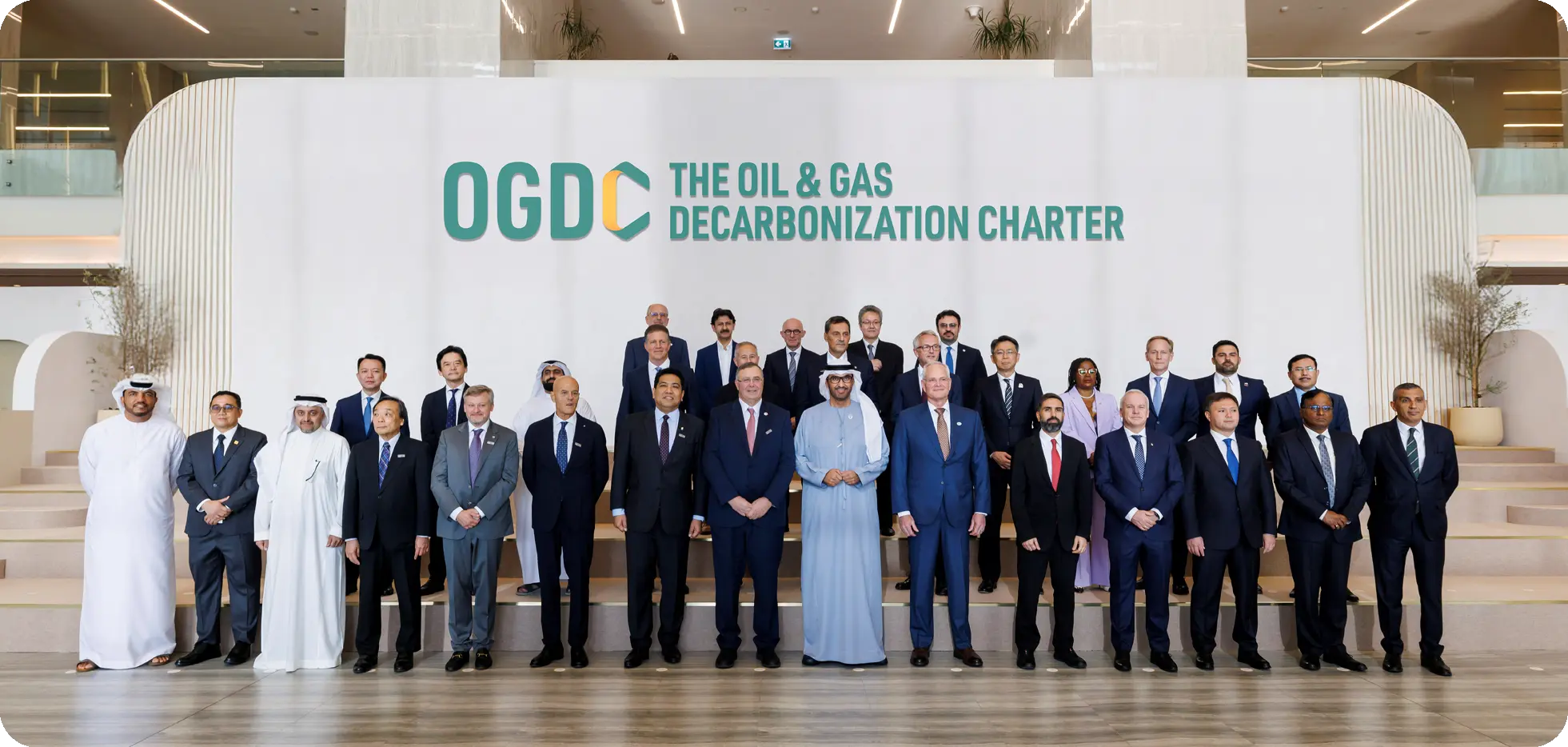
Today, the Charter brings together 55 signatories – up from 50 at its launch – with operations across more than 100 countries, representing around 35% of global oil and gas production. Importantly, two-thirds are national oil companies (NOCs), underlining OGDC’s unique reach and scale.
The Charter’s purpose remains clear – to support signatories in their decarbonization efforts, achieve broad geographical coverage, and scale impact by sharing knowledge, accelerating learning and facilitating transparent reporting.
OGDC entered 2025 with a clear set of priorities:
- Track progress through companies’ reported data;
- Reduce methane and flaring emissions, supported by ambitions and action plans towards 2030; and
- Increase Collaborate & Share best practices.
Better data, increased transparency
OGDC signatories continue to align around three shared ambitions that reflect the sector’s contribution to the aims of the Paris Agreement:
- Achieve net-zero operations (Scope 1 and 2) under signatories’ control by or before 2050;
- Reach near-zero methane emissions in upstream operations by 2030; and
- Eliminate routine flaring by 2030.
In 2025, 50 of 55 signatories submitted data, representing 98% of OGDC operated production. 42 signatories have now set interim Scope 1 and 2 ambitions, demonstrating alignment with the aims of the Charter. This is up six from the 2024 baseline survey. Three companies submitted the OGDC survey for the first time, two established their first company-wide baselines and 35 provided previously unpublished performance data to the OGDC Secretariat. This marks a significant improvement in coverage and consistency since the Charter’s first report.
Accelerating action on methane and flaring
Methane and flaring action plans have increased. 80% of signatory production is covered by action plans on flaring and methane. This year, 11 more companies have set action plans since the 2024 baseline.
The report shows multiple examples of company case studies to reduce methane emissions, including satellite programs, drones and sophisticated detection technologies, as well as infrastructure improvement, workforce training and capacity building.
Companies across the Charter point to OGDC as a catalyst that has accelerated their methane mitigation actions. In 2025, OGDC’s Collaborate & Share featured 13 webinars and 15 individual company training sessions focused on methane reduction efforts. OGDC continues to encourage better reporting and more complete methane data.
Bending the curve
This year, for the first time ever, companies shared emissions data based on the OGCI Reporting Framework, laying the foundation for uniform reporting across 55 companies. OGDC’s success depends on the implementation of tangible actions. Signatories are increasingly implementing best practices, including methane emissions monitoring and electrification of operations.
Looking ahead
These positive trends reflect the culture shift that OGDC is working to foster across more than 50 different companies and over 100 countries. The scale of the challenge remains – but the significant progress to date shows that with continued leadership from the CEO Champions and signatory companies, real results can be achieved.
Implementing action and measuring progress are core elements for delivering the OGDC mission. This will continue. The foundation for ongoing measurable progress is in place, providing a platform for signatories to build on. OGDC signatories remain committed to achieving the aims of the Charter, under the leadership of the three CEO Champions.
These strong foundations provide confidence that in 2026 OGDC will demonstrate measurable progress on reducing emissions, better reporting, and more action plans – among other priorities. This 2025 Status Report highlights the foundation that has been built in the past two years: that foundation is also a launching pad for OGDC to aim even higher in the years ahead.