Chapter 2
Collaborate & Share
AOW Energy, 2026
COLLABORATE & SHARE IN NUMBERS
As of October 2026
IEF Industry Advisory Council Meeting, 2026
regional engagements across the Gulf, Latin America, Southeast Asia, and West Africa.11
signatory staff engaged via regional engagements.12
signatories supported with methane emissions monitoring through the OGCI Satellite Monitoring Campaign with 40+ assets monitored.13
signatory companies engaged through the Collaborate & Share program, alongside 18+ non-OGDC signatories.14
mentorships and peer-to-peer programs.15
new Collaborate & Share modules on Energy Efficiency in Industry (EEI) launched with Worley and OGCI.16
signatory staff participated in technical support activities, with four technical support projects delivered this year.17
signatory professionals and engineers trained in the last year, and a total of over 4,000 combined since launch.18
HOW OGDC SUPPORTS SIGNATORIES

REPORTING GHG EMISSIONS DATA
OGDC supports signatories with technical expertise to establish a first baseline of GHG emissions or GHG emissions inventories through the use of measurement-based methane emission factors and the reconcilation of top-down and bottom-up emissions estimates.
DESIGNING A DECARBONIZATION STRATEGY AND SETTING AN AMBITION
The Secretariat offers technical support to signatories on their respective decarbonization planning, including the development and review of marginal abatement cost curves (MACCs) and the consideration of emissions-mitigation opportunities and strategies.
ACTIVATING IMPLEMENTATION PLANS
As signatories develop more robust emissions data and their individual decarbonization strategies, action plans can help translate their ambitions into more focused mitigation activities. OGDC provides technical support, as needed, to help address identified priorities.
ADVANCING AMBITIONS AND SUPPORTING OTHERS
OGDC works to connect signatories at different stages of their decarbonization journey, enabling companies with relevant experience to share knowledge, high-level best practices, lessons learned, and practical approaches that may support other signatories’ emissions mitigation efforts. These activities provide opportunities for staff training, capability development and further technical collaboration among participating organizations.
Aramco, 2026
THE SIGNATORY JOURNEY
OGDC’s strength lies in its extensive geographical and experiential reach. The Decarbonization Charter’s 56 signatory companies operate roughly one-third of global oil and gas production across more than 100 economies, both emerging and mature.19
By pairing this extensive base of industry knowledge with the expertise of external partners and a broader group of energy stakeholders, the Collaborate & Share program makes it possible to offer signatories the support they need to advance their decarbonization goals, wherever they may be on their individual journeys.20

"As a founding signatory of the Oil & Gas Decarbonization Charter, ADNOC places real value on disciplined delivery by turning our commitments into measurable results. In 2025 we met our target to keep upstream methane intensity below 0.15%, achieving 0.05%. This reflects the strength of our methane management approach and keeps us on course toward our ambition of near-zero methane emissions by 2030, an aim of OGDC. There is more to do, and we remain focused on steady, transparent progress alongside our OGDC partners.” 21
Chief Sustainability & ESG Officer, ADNOC
TURNING DATA INTO ACTION
Building methane emissions baselines with MIST

Establishing a methane emissions baseline is a critical first step toward reducing emissions, yet a number of operators lack the tools and expertise to do so. To help close this gap, several OGDC signatories have been supported through the deployment of the Methane Inventory Systematic Tool (MIST), a free software platform that enables companies to build their methane emissions inventories and identify mitigation opportunities.
Read more
Developed by Carbon Limits with funding and technical support from several philanthropic funds and industry initiatives, including OGCI, MIST quantifies individual companies’ emissions from key sources including venting, fugitive leaks, incomplete combustion, and flaring in line with OGMP 2.0 reporting requirements. The tool allows companies to generate a Level 3 inventory from limited data and progressively improve accuracy as additional information and advanced quantification measurements become available.
Through OGDC’s methane capacity-building efforts, MIST has been deployed with six OGDC national oil company signatories during 2025-2026. Globally, the tool has helped more than 40 operators improve their understanding of emission sources and assess reduction opportunities.22 Several signatories are using MIST to strengthen their OGMP 2.0 reporting, including the development of Level 3 inventories and, in some cases, reporting at Levels 4 and 5.
Beyond emissions quantification, MIST evaluates data quality, estimates abatement potential and assesses mitigation costs, helping individual companies develop targeted methane emissions management plans, and supporting signatories to move from baseline development to methane mitigation action.
Carbon Limits, 2026
SUPPORTING DATA-DRIVEN PLANNING
Strengthening decarbonization plans through asset-level analysis at Azule Energy

As part of its mission to accelerate emissions reductions across the oil and gas sector, OGDC supported a focused technical engagement between Azule Energy and McKinsey & Company to strengthen the operator’s understanding of emissions reduction opportunities at asset level.
Read more
Throughout the engagement, McKinsey worked closely with Azule’s operational and technical teams to conduct a detailed review of marginal abatement cost curves (MACCs) for selected assets within Azule’s portfolio.
Together, the team assessed the robustness of baseline assumptions, enhanced the understanding of emissions sources and refined estimates for methane, flaring and CO2 emissions. The project also reviewed the technical and economic assumptions underpinning existing abatement opportunities, resulting in updated asset-level MACCs and a clearer view of cost-effective emissions reduction pathways.
The updated analysis provided Azule with a more comprehensive understanding of emissions sources, mitigation potential, and investment priorities.23 Results are now being used to in-form future planning.
Building on the success of the initial phase, Azule is extending the MACC review across additional assets, identifying decarbonization levers, and strengthening mitigation action plans. The effort prioritizes reduction of flaring, methane, and process emissions, helping translate analysis into measurable emissions reductions across the portfolio.
Azule, 2026
FROM DETECTION TO RESPONSE
Scaling methane action through satellite monitoring

Detecting methane leaks is a critical first step towards reducing them. Building on more than five years of experience deploying advanced methane emissions monitoring technologies across a diverse set of national and international operators, OGCI expanded its flagship upstream methane monitoring programs to support OGDC signatories, helping operators identify and address emissions that may otherwise have gone undetected, as well as broaden access to methane monitoring technologies across a diverse set of national and international operators.
Read more
OGCI’s approach combines technology, technical expertise and operator engagement. Through partnerships with GHGSat, aircraft-based monitoring providers, and Carbon Mapper, the OGCI Secretariat provides individual operators with high-resolution methane observations over selected assets. The Secretariat additionally supports operators in interpreting results and identifying corrective actions. Previous OGCI Satellite Monitoring Campaigns in Iraq, Algeria, Kazakhstan and Egypt have demonstrated how satellite data can help operators locate significant methane emissions and support mitigation efforts.
In 2024-2026, this support was extended through OGDC. As of September 2026, over 5 OGDC signatories have received satellite monitoring data from OGCI, covering more than 40 assets and generating over 300 observations and 150 methane detections.24 The program is complemented by technical follow-up, webinars, peer learning and bilateral support to help operators investigate and address identified emissions. In 2025, OGCI published a satellite detection response playbook, aiming to provide practical guidance for operators to understand and respond to detections – now available in six languages.
As a result of these efforts, multiple OGDC operators have shared feedback and undertaken follow-up and mitigation actions.
OGCI and OGDC continue working to expand monitoring coverage, incorporate additional public data sources, and strengthen technical support to help signatories translate methane detections into methane management activities across their respective portfolios.
GHGSat
PETROBRAS AND TOTALENERGIES
Innovating and collaborating to reduce the carbon intensity of offshore operations

Read more
Petrobas, 2026
REGIONAL ENGAGEMENTS: JOINING HANDS ACROSS BORDERS
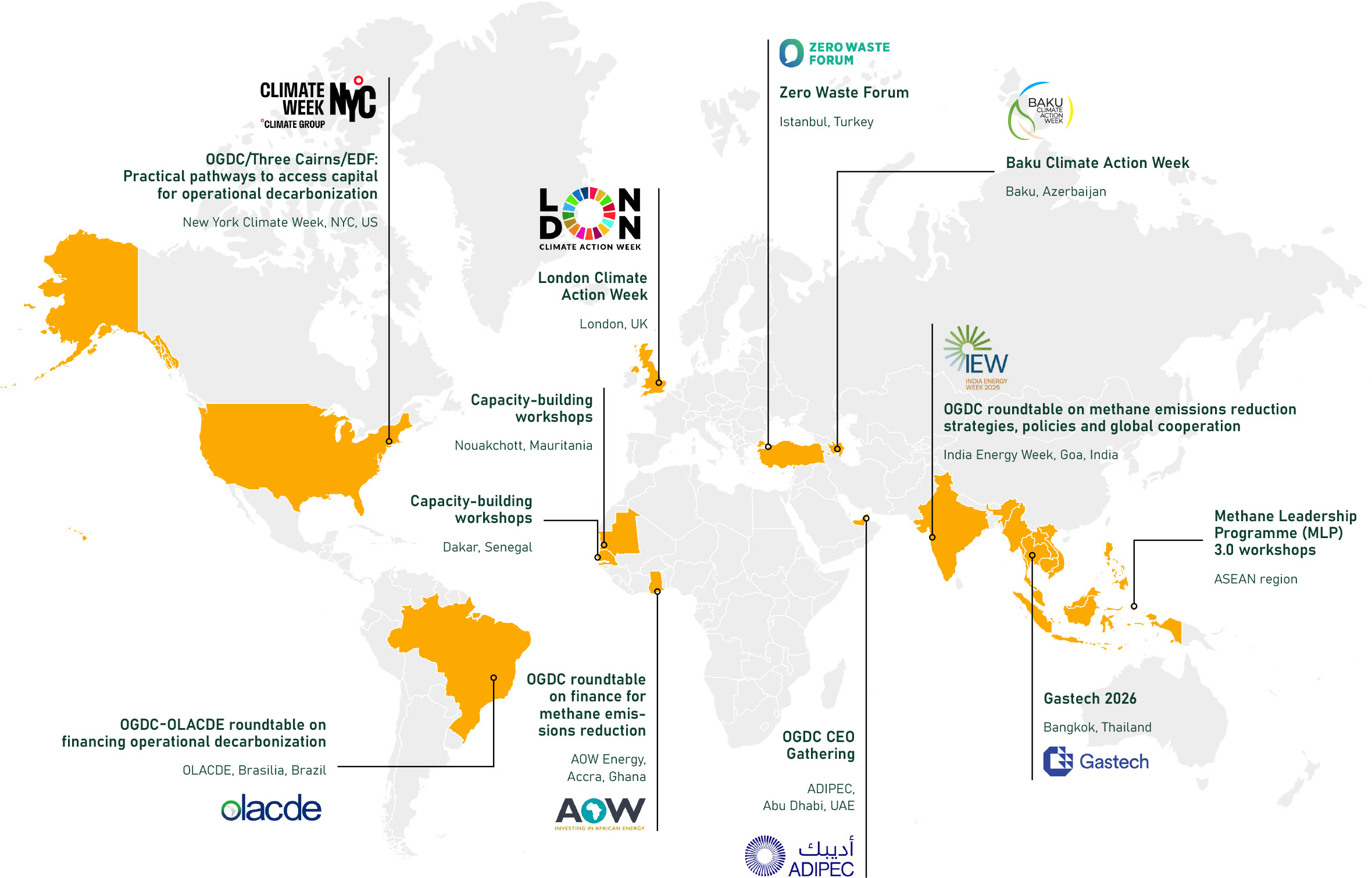
Alongside peer-to-peer networking, regional engagement has become an increasingly important pillar of the Collaborate & Share program. Each region has unique geographical, operational, and regulatory characteristics, which is why engaging directly with operators is essential to ensuring decarbonization efforts are practical and work in local contexts. In the past 12 months, the Secretariat has worked closely with signatories and partners in the Gulf, Latin America, Southeast Asia, and West Africa.
INDIA ENERGY WEEK
Strengthening methane measurement through regional collaboration
In January 2026, OGDC convened a roundtable at India Energy Week that brought together operators, national stakeholders, and international organizations such as the IEA, the World Bank, and the Environmental Defense Fund (EDF) to discuss how to translate methane reduction aims into action throughout India and Central Asia.
Read more
The discussion focused on India’s unique consid- erations in the energy transition, the balance it must strike between rapidly rising demand and expanding infrastructure, and the need to cut emissions, while maintaining secure and affordable supply. Participants highlighted methane reduction as one of the most immediate opportunities available to the sector, while acknowledging that success here will require stronger measurement, reporting, and verification.
A presentation on the collaboration between TotalEnergies and Oil India (OIL) illustrated what implementation looks like in practice.25 Through the deployment of its AUSEA drone-mounted technology across several sites around Duliajan, Assam, TotalEnergies helped OIL gain a better understanding of its methane and CO2 emissions. These insights have helped OIL develop a data-driven roadmap toward near-zero up-stream methane emissions. Such bilateral coop- erations between IOCs and NOCs build capacity, accelerate learning, and demonstrate what is possible for the industry.
The energy transition will not look the same everywhere. By anchoring conversations and collaborations in each region’s specific context and through engagement with its operators, OGDC seeks to develop support and solutions that fit signatories’ unique operating conditions and accelerate progress at scale.
OGDC IN SENEGAL AND MAURITANIA
Early-stage methane management opportunities
Embedding methane emissions minimization practices into operations at the outset can deliver cost, operational, and environmental benefits. This was a central theme of OGDC’s engagements in Senegal and Mauritania.
Read more
In May 2026, OGDC co-organized technical workshops with bp that brought together operators, regulators, technical partners, and international institutions across both countries to discuss methane management. The sessions, which drew on the experience of stakeholders from Senegal, Mauritania, Nigeria, and Angola, provided a forum for the sharing of technical knowledge and important on-the-ground lessons.26
A clear theme emerged: When built into an asset from the start, methane management is far easier and often more cost-effective. On a Floating Production, Storage, and Offloading vessel (FPSO), for example, space and weight constraints make adding infrastructure post-commissioning a challenge. In some cases, it might require shutting down parts of a facility.
These are considerations that go beyond equipment. Personnel must be trained, processes for calibration and maintenance developed, and approaches for prioritizing an asset’s emissions sources determined.
The Decarbonization Charter is designed to help address these gaps. Through the Collaborate & Share program, signatories can access 1:1 training, tailored technical support and a repository of resources on methane management. OGDC works with OGCI member companies and partner organizations, including EDF, UNEP, the World Bank, IOGP, Ipieca and RMI, to provide practical resources and technical expertise.
AOW ENERGY
Advancing methane action and capital mobilization in Africa
In September, OGDC held a series of engagements alongside AOW Energy in Accra, Ghana, bringing together African regulators, NOCs and IOCs, finance institutions, technical and international organizations for dialogue on methane, financing, and upstream sustainable development in Africa.
Read more
A 1.5-day workshop, held in collaboration with the African Petroleum Regulators Forum (AF- RIPERF), with contributions from Shell, brought together regulators and operators to share experiences from different national and operating contexts. Discussions emphasized the importance of credible emissions data and robust measurement, reporting and verification (MRV) systems as the foundation for effective regulation, improved transparency, and access to finance. Participants also highlighted the value of continued peer exchange to accelerate implementation and share practical lessons.
Alongside the workshop, an OGDC executive roundtable brought together operators, finance institutions, and technical organizations to examine access to capital for methane abatement. A key takeaway was that unlocking finance is not only about the availability of capital. Projects must be structured and presented in ways that make them investable, while stronger understanding between operators and financial institutions can help bridge the gap between technically viable opportunities and financing requirements.
Across both events, participants highlighted the significant progress already underway in several African markets on emissions reporting, methane regulation, and financing approaches. Bringing together these experiences created opportunities to share expertise, showcase local innovation, and strengthen collaboration across the region.
Aramco is proud of our leadership in lower-carbon innovation and technology, which has helped to maintain our upstream methane intensity at 0.04%, well below the Charter’s near-zero benchmark of 0.2%. Aramco’s approach to sharing high-level best practices with OGDC signatories delivers positive impacts around the world, supporting OGDC signatories’ efforts to advance emissions-reduction solutions across the oil and gas sector. Under the leadership of our President and CEO, Amin H. Nasser, Aramco is focused on continuous improvement and our ambition to achieve net-zero Scope 1 and 2 emissions across our wholly-owned operated assets by 2050.” 27
Musaab Al-Mulla, Vice President of Market Analysis & Sustainability, Aramco
ORGANIZACIÓN LATINOAMERICANA Y CARIBEÑA DE ENERGÍA (OLACDE)
Access to finance for methane abatement across Latin America and the Caribbean (LAC)
During the 2026 III Regional Methane Summit, OGDC co-organized an executive roundtable on financing methane mitigation with OLACDE. This gave operators, industry associations, capital providers, and NGOs a venue to discuss regional opportunities and challenges relating to methane emissions.28
Read more
Growing global focus on operational decarbonization, coupled with the region’s specific operating conditions, including its mature infrastructure, new asset developments, and evolving financing models, shaped the session. Participants shared their experiences and lessons learned, along with obstacles facing methane mitigation projects. Information gaps, shortfalls in data quality, and limited access to capital were identified as factors constraining progress. Yet stakeholders remained optimistic about the work ahead. The session highlighted that meeting decarbonization targets will require collaboration between individual operators and capital providers.
This engagement formed part of OGDC’s broader work on financing operational decarbonization. Alongside its dedicated financing workstream, OGDC has facilitated a number of discussions on financing related topics in different regions. This roundtable offered a valuable opportunity to improve mutual understanding and engagement between regional operators and the financial ecosystem.
OLACDE, 2026
2026 OGDC ENGAGEMENTS
PEER-TO-PEER COLLABORATION: THE IMPACT OF CONNECTION
To ensure those closer to the start of their decarbonization process can benefit from the wisdom of those further along, OGDC works to link companies seeking guidance with those willing and able to offer it.
Guidance can come in various forms: from the sharing of expertise in bilateral meetings to formal agreements involving technology transfers and on-site visits. By adopting a flexible approach, the Collaborate & Share program lets companies set the objectives and parameters that work best for them.29
This year alone, the program has facilitated five mentorship and peer-to-peer relationships between signatories.
OGDC’s connection to the OGCI and its member companies adds to the impact and reach of its peer-to-peer network. As the Charter’s Secretariat, OGCI leverages over a decade of decarbonization experience to help signatories strengthen their individual upstream methane emissions measurement and mitigation efforts.
OGCI’s Satellite Monitoring Campaign is available to signatories seeking to detect and reduce upstream methane emissions, while its Methane Hub is a repository of key insights into management of this potent greenhouse gas.
Since the last OGDC update, over five signatories have gained valuable intelligence about their methane emissions through OGCI’s Satellite Monitoring program, which gathered and supplied data relating to more than 40 assets.
Through our commitment to the OGDC, TotalEnergies is determined to play its part in the collective effort to drive methane emissions toward near zero. Accurately measuring emissions is essential to relentlessly reducing them. With our 13,000 sensors and our MethaneLive monitoring center, we combine real-time data, technology and the expertise of our teams to detect methane emissions faster and take action. And today, these efforts are paying off: we are on track to achieve our target of reducing methane emissions by 80% by 2030. On our non-operated assets, we proactively engage with our partners to share our best practices. This reflects our commitment and our conviction that, by working together, our industry can make a real difference in the fight against methane emissions.” 30
Three years ago, OGDC set out to demonstrate what industry leadership on methane could look like on the path to achieving near-zero methane emissions by the end of 2030. Since then, signatories have strengthened measurements, developed action plans, and increased collaboration, particularly among national oil companies. These early steps are important. The next challenge is scaling impact, and that will require greater transparency through company-level reporting that builds trust, drives accountability, and accelerates emissions reductions.”31
Environmental Defense Fund
ONS, 2026
Our early projects have taught us quite a bit about what it takes to reduce methane and end routine flaring in developing countries, where limited resources and technical capacity are typically the starting point. The keys to well-designed projects and success are long-term, self-sustaining financing mechanisms and building government and operator expertise by implementing projects together. OGDC has been a leading contributor to the global agenda, helping build capacity, improve measurement and operational capability. It’s what we need to help accelerate progress.” 32
TRAINING AND TECHNICAL SUPPORT: FROM COLLABORATION TO IMPLEMENTATION
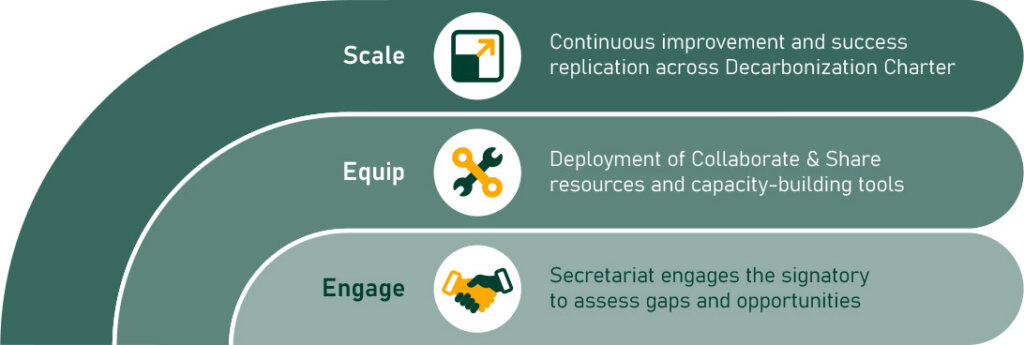
With signatories from all regions of the world and at all stages of the decarbonization process, the Collaborate & Share program has sought to make training and technical support flexible, adaptable, and continually responsive to signatory feedback and evolving industry trends.
Through 1:1 training, customizable modules, expert- led webinars, and on-demand resources, OGDC supports signatories in translating learning into meaningful company-level action, thereby galvanizing progress toward Charter goals.
OGDC has worked with expert consultants Accenture, Carbon Limits, McKinsey, S&P Global Energy and Worley Consulting to develop an array of modules on such mission-critical topics as emission types, global measurement standards and best practices, the creation of strong decarbonization roadmaps, project financing, advanced upstream methane emissions monitoring technologies, and internal energy efficiency.33
Online seminars, meanwhile, offer insights from peers and partners on the most pressing issues related to decarbonization today. In 2026, signatories had access to 10 such webinars, which delved into subjects ranging from methane detection and mitigation to success stories in improving operational energy efficiency. Together, these sessions engaged hundreds of staff across the signatory community.
BUILDING MEASUREMENT-BASED DATA
Methane LDAR and measurement campaign at African NOC
As part of the Collaborate & Share program, OGDC enabled the execution of a two-week methane Leak Detection and Repair (LDAR) measurement campaign at a large African NOC flagship asset.
Read more
Using a combination of high-flow sampler and optical gas imaging, the team identified 96 leaks, representing estimated annual emissions of 253.9 tonnes of methane. Seven leaks were repaired and verified during the campaign, and three further repairs were reported afterward but await verification. Of the leaks identified, approximately 52% were assessed as likely straightforward repairs, with the potential to avoid around 60 tonnes of methane annually if repaired and verified.
During the campaign, Carbon Limits trained 38 staff, with 17 receiving intensive hands-on field training. Participants learned how to conduct surveys, assess measurement technologies, and oversee future campaigns.
The operator had an existing methane inventory based on generic emission factors, consistent with OGMP 2.0 Level 3 reporting. The campaign was designed to build on that foundation by introducing asset-level measurement data, giving the team a clearer basis for understanding emission sources and targeting reductions.
Replacing generic emission factors with measurement-based data changed total estimated emissions from that asset from ~4,800 to 2,300 tonnes of methane per year. These changes reflect an updated, improved inventory rather than emissions reductions achieved through repairs.
The campaign supported the operator to identify methane reduction opportunities, improve emissions quantification, and strengthen internal capability for ongoing methane management. Alongside this, it strengthened the operator’s skills and capacity to tackle methane emissions and provided a basis for building teams and processes to sustain the work. This could further help to explore similar campaigns elsewhere, with potential support from OGCI, OGDC, and other international organizations.
SHARING ENERGY EFFICIENCY EXPERTISE
OGCI’s Energy Efficiency in Industry (EEI) collaboration with OGDC

Since its very beginnings, OGDC has drawn upon natural synergies with OGCI to offer signatories guidance and targeted training courses.
In early 2026, the two organizations joined forces to craft four in-depth EEI training modules for the Collaborate & Share program. The training provides a holistic overview of this important subject, from industry best practices and critical opportunities to proven energy management processes.
Read more
The modules were developed with support from EEI experts at OGCI member companies and are delivered by Worley Consulting.34
The OGCI EEI workstream is co-led by Aramco and Chevron. Available to all signatories, the training can be delivered either virtually or face-to-face. Modules can also be adapted to local contexts, with support from on-the-ground experts where needed.
The offerings, which can be taken together or separately, cover the fundamentals of energy efficiency in upstream operations, including common methods for optimization, changes over the lifespan of an asset, and the essentials of how to set up, maintain, and audit an energy management system (EnMS).
And to help signatories encourage company-wide adoption, there are expert tips on how to educate staff on the benefits of more efficient energy use: from lower costs and higher revenue to reduced emissions and safer and more reliable operations.
NAVIGATING DECARBONIZATION FINANCE
Unlocking finance for operational decarbonization
While upstream methane emissions reduction, routine flaring and energy-efficiency projects may present economic opportunities, operators can face practical challenges in progressing these initiatives into funded, executable emissions reduction projects.
In 2026, OGDC established a dedicated work-stream on financing operational decarbonization to better understand the barriers affecting capital access for decarbonization projects. Insights shaping the effort were gathered through discussions at OGDC events and workshops, bilateral exchanges with NOCs and financial institutions, and participation in industry forums.35
Read more
To develop actionable recommendations, OGDC convened a group of supporters, including EDF, Three Cairns Group, PIMCO, the Sustainable Markets Initiative (SMI) and McKinsey & Company. The work drew on perspectives from across the energy value chain and financial sectors, including NOCs, international operators, commercial banks, asset managers, and development finance institutions.
The resulting guidance document is designed for operators seeking to move from identifying emissions mitigation opportunities to securing financing and implementation. It outlines key considerations related to project prioritization, investment preparation, financing requirements, and financing structures for methane reduction, routine flaring and energy efficiency projects. The guidance includes practical templates for project preparation, examples of successful financing structures, case studies of real-world decaronization projects, and recommendations for engaging both internal decision-makers and external financiers.36
The guidance document is scheduled for publication. OGDC intends to continue working with its partners and provide a forum for high-level discussions on financing challenges related to methane emissions mitigation, routine flaring, and CO2 emissions mitigation projects.37
Atlantic Council Global Energy Forum, 2026
EXTERNAL PARTNERSHIPS: BUILDING AN ECOSYSTEM
From its inception, OGDC has sought to foster a shift toward operational decarbonization not just among signatories but across the broader industry. To this end, the Secretariat maintains an ongoing dialogue with technical experts, external partners, academia, service providers, and industry bodies to encourage and facilitate the exchange and dissemination of knowledge.
Through these avenues of engagement, OGDC aims to support more scalable progress across the sector and to encourage signatories to pursue their efforts to lower emissions across the globe.
Partnerships with nearly a dozen external partners also help ensure robust support for signatories as they develop and implement their emissions mitigation plans.
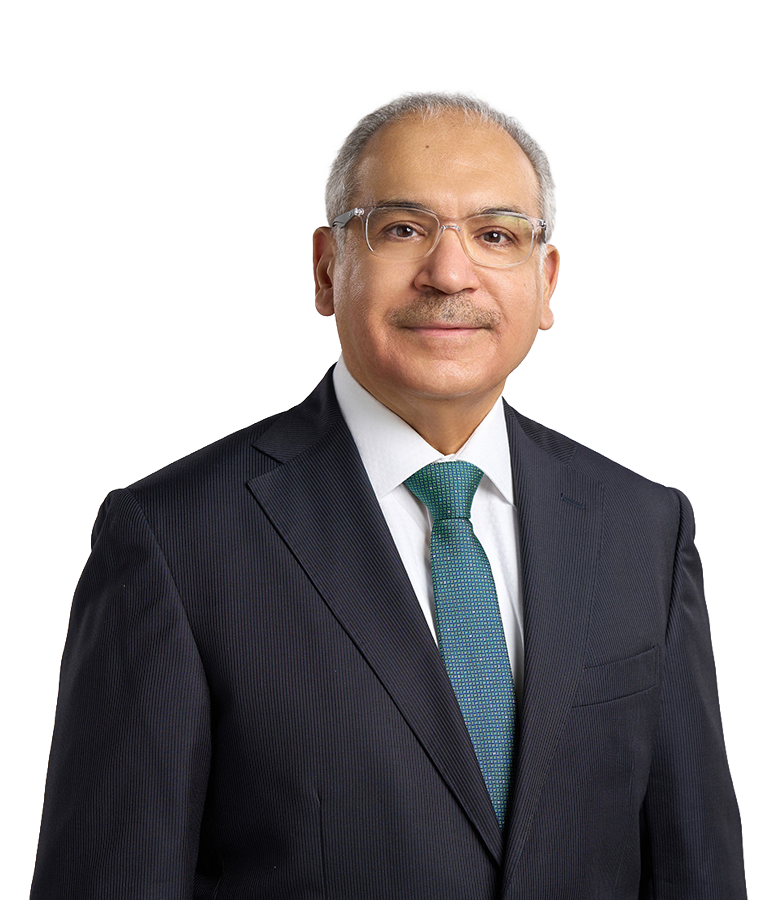
In an increasingly complex global energy landscape, delivering emissions reductions across the oil and gas sector requires governments and industry to work together. Our collaboration with OGDC and their participation in the IEF Industry Advisory Council (IAC) strengthens that dialogue, helping to share practical solutions and support emissions reduction, while deepening engagement across the sector and supporting secure and affordable energy systems.” 38
Jassim Alshirawi, Secretary General, International Energy Forum (IEF)
In 2026, the Charter signed a memorandum of understanding (MoU) with the IEF: a pledge to work together to deepen public–private collaboration and accelerate industry-wide decarbonization.
By facilitating dialogue, regional engagements, peer-to-peer connections, training and technical support, Collaborate & Share gives oil and gas companies of all sizes and at all phases of decarbonization the chance to benefit from the knowledge of peers, industry experts, and external partners.
Since the last update, more than 1,800 signatory company employees have benefited from training, webinars, and regional engagements, while OGDC has convened dozens of bilateral sessions and peer-to-peer connections. Meanwhile, the methane mitigation efforts at over five companies received support through the OGCI Satellite Monitoring Program.
Together, all of these OGDC-led efforts are helping signatories progress toward their decarbonization goals.
IEF, 2026
Partners

COLLABORATE & SHARE IN PRACTICE