OGDC 2026 Status Report
CEO Champions foreword
Aramco, 2026
CEO Champion Foreword
Progress through action
The Oil & Gas Decarbonization Charter (OGDC) is advancing collective ambition through practical action and growing cooperation on mitigating operational emissions.
Its 56 signatories, operating in more than 100 countries, represent approximately one-third of global oil and gas production. Against a backdrop of geopolitical unpredictability, disrupted energy markets and competing operational pressures, all signatories have maintained their focus on the Charter, underscoring the durability of this initiative and the OGDC signatories’ shared resolve to deliver real progress.
Meeting the world’s growing energy demand requires progress on three fronts in parallel and in a balanced way: security, affordability and sustainability. Despite regional disruption in the Middle East, OGDC continues to serve as a multilateral platform that unites signatories from the U.S., Europe, the Gulf region, India, Africa, South America, and Asia, to address the energy trilemma head on.
OGDC signatories recognize that reducing avoidable emissions is an immediate and practical contribution the industry must make while continuing to provide the energy the world demands, improve efficiency, and strengthen resilience. Innovation and technologies, including AI, will be essential to both lowering emissions today and building the energy systems of the future.
This year’s report shows that signatories are firmly focused on implementation. 52 of 56 signatories reported data covering 97% of OGDC operated production, providing OGDC’s clearest picture yet of collective progress. 30 companies also shared previously unpublished data, strengthening the evidence base.
Importantly, the data shows measurable advances since the 2024 baseline. 46 signatories, covering 96% of operated production, have set voluntary interim 2030 Scope 1 and 2 ambitions, while more than 80% of production is covered by action plans on emissions, methane and routine flaring. These are major steps from commitment towards delivery.
Yet reporting maturity, data quality and assurance remain uneven. Better data enables companies to pinpoint emissions sources, target investment and technology, and measure results. Each reporting cycle helps strengthen signatories’ ability to deploy innovation and access the support needed to accelerate emissions reductions.
That is why OGDC exists: to accelerate progress across the industry, supporting companies at every stage of their journey to help lower emissions. Through the Collaborate & Share program, OGDC helps companies move forward from different starting points. More than 4,000 signatory professionals have joined technical workshops and training – 10 times the number reported in OGDC’s first baseline report in 2024. Through training, mentorships and case studies from peers, OGDC is turning shared experience into practical capability. This is the Charter’s strength: companies learning from one another to advance voluntary ambitions, while each remaining accountable for its own progress.
Beyond industry, we welcome the positive feedback from UNEP, the IEA and EDF in their independent report, including their encouragement for more companies to join the Charter. We are also grateful to the G7 and COP Presidencies for their constructive challenge, support, and momentum.
Our direction is clear. With four years remaining to deliver on the Charter’s 2030 ambitions, the priority is sustained implementation: improving reporting, turning plans into projects, scaling proven technologies and expanding outreach.
The progress reflected in this report is only possible because of the continued leadership and efforts of each signatory company. We thank all signatories for their contributions.
As CEO Champions, we remain focused on leading OGDC through these unpredictable times, staying the course on the ambitions of the Charter, and working with OGDC signatories to deliver measurable progress.
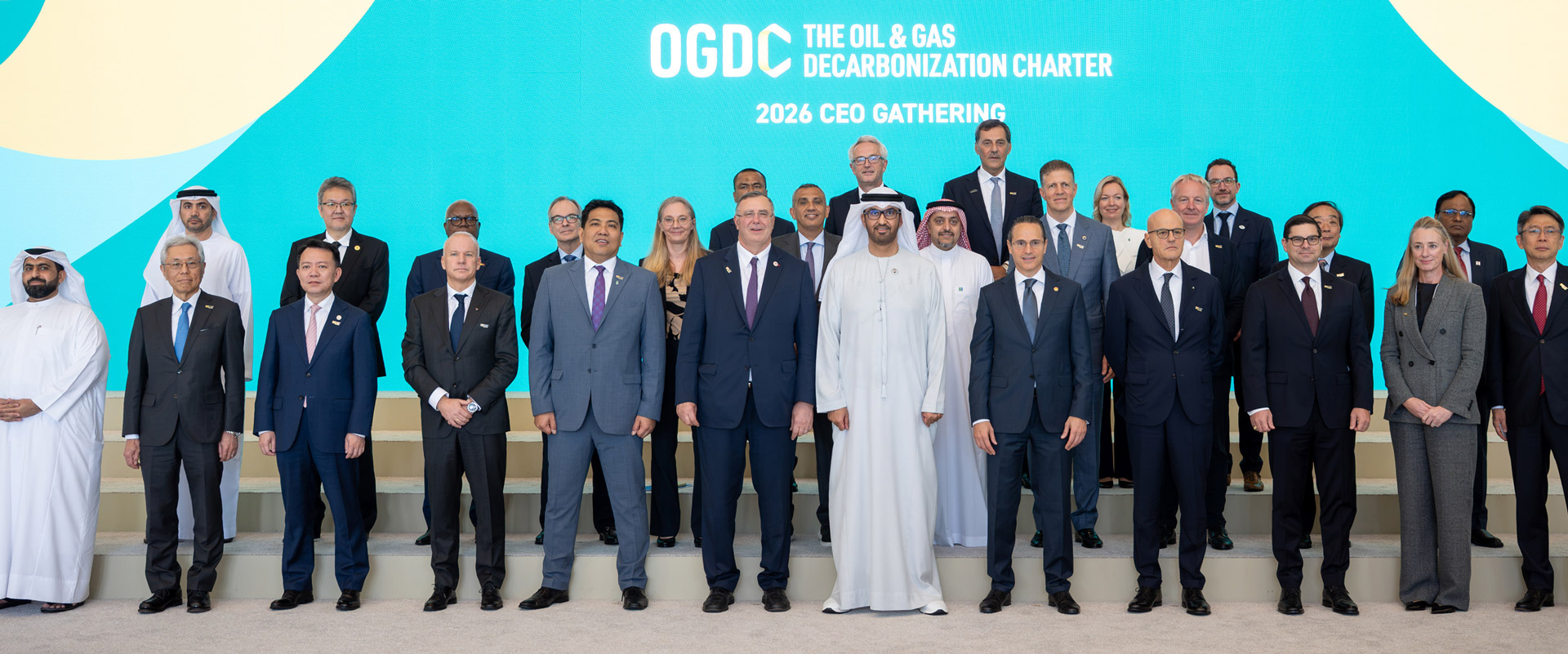

Dr Sultan Al Jaber
Managing Director & Group CEO, ADNOC

Amin H. Nasser
President and CEO, Aramco

Patrick Pouyanné
Chairman and CEO, TotalEnergies
Executive Summary
As global energy demand continues to grow, the industry is working toward mitigating its own operational emissions while investing in the energy systems of the future.
Against this backdrop, OGDC brings national oil companies (NOCs) and international oil companies (IOCs) together to collaborate on key operational emissions priorities, including methane emissions and routine flaring. At the heart of this approach is collaboration, enabling companies at different stages of their decarbonization journeys to share knowledge, build capabilities and turn experience into practical action.
As of October 2026, OGDC has 56 signatories in more than 100 countries which operate around one-third of global oil and gas production.1
In the three years since its launch, signatories from around the globe, nearly two-thirds of which are NOCs, have worked to progress against Charter aims. This year’s report highlights signatories’ continued efforts. An increasing number of companies are disclosing more information on their emissions, setting interim ambitions, and developing action plans to achieve them year on year.
Year-on-year increases can be seen across emissions reporting, interim ambition-setting and action plans. For this year’s report, 49 signatories reported having a Scope 1 and 2 emissions reporting process in place, four more than in the 2025 Status Report, while 46 reported interim Scope 1 and 2 ambitions, up from 42 in last year’s report.
This year’s report draws on data from 52 of 56 signatories representing 97% of OGDC operated production, marking the highest level of company-reported data yet. 30 signatories also provided information not currently disclosed publicly, further strengthening the evidence base.
To strengthen confidence in the aggregate data, the Secretariat also commissioned EY to provide limited assurance over selected OGDC indicators (see EY’s assurance statement).2
These improvements in participation, transparency, and reporting are helping build the mutual trust and professional ecosystem that underpins OGDC’s approach.3 The Secretariat undertakes this responsibility with a commitment to sound stewardship and due diligence.
OGDC reporting shows notable progress in both the quantity and quality of data collected and disclosed. Adoption of the Oil and Gas Climate Initiative (OGCI) Reporting Framework in 2025, combined with continued engagement and growing signatory familiarity, strengthened consistency in 2026. More rigorous checks and increased transparency over qualitative and quantitative progress indicators have further reinforced the credibility of the reporting process.
This stronger reporting is complemented by practical collaboration. OGDC’s Collaborate & Share program and the OGCI Satellite Monitoring Campaign support stronger measurement, reporting and mitigation, particularly for methane emissions efforts. More than 4,000 signatory professionals and engineers have been trained through the Collaborate & Share program since OGDC’s launch, helping turn shared experience into practical capability.

Lowering global methane emissions is an imperative and the active involvement of NOCs is essential to achieve the much-needed reductions at speed and scale. The challenge now is implementation - bringing companies and other relevant stakeholders together around practical solutions, robust data and transparent reporting to deliver measurable results. OGDC has an important role to play to drive that progress across the global oil and gas sector.” 4
Ambassador Patricia Espinosa, Former Executive Secretary, UNFCCC, CEO and Founding Partner, OnePoint5

Transparency has improved significantly, providing a clearer view of OGDC’s scale and its operational emissions profile. In 2025, OGDC operated production reached 58 Mboe/d—around one-third of global oil and gas production. 47 signatories, representing 88% of total production, reported approximately 840 Mt CO2e in Scope 1 and 2 emissions. The preliminary estimate for upstream carbon intensity was 22 kg CO2e/boe, while aggregate upstream methane emissions were estimated at 3 Mt CH4. Total OGDC upstream flaring volumes were 28.6 billion cubic meters, representing roughly 17% of global flaring volumes.
Continued improvement in reporting maturity, data quality, and assurance will be important for strengthening this picture further. Transparent reporting remains central to the Charter’s approach to tracking progress. The Secretariat will continue working with companies to improve reporting, strengthen data quality, and help identify areas for further improvement.
Qualitative assessments also highlight encouraging progress across signatories, reflecting their different starting points and operating contexts. Promoting robust disclosure practices and building trust across a diverse signatory base is an iterative process, and OGDC continues to encourage complete and accurate reporting for all signatories. The progress achieved within three years provides a strong foundation for continued implementation.
The priorities now are to increase direct and independently verified reporting, improve completeness and comparability across signatories, and build a more robust basis for tracking operational emissions over time.
OGDC will remain focused on supporting signatories to improve reporting, turn plans into projects, scale proven technologies, and strengthen collaboration.